White label apps are pre-built, customizable apps that are fast to deploy and budget-friendly. If you’re a business that relies on developing apps at scale for customers, you’ll feel the immediate impact of this enterprise-friendly option. Read more to learn about white label apps, their pros and cons, and how you can use Median.co to build your very own.
Building a custom mobile app from scratch takes months and costs more than most teams budget for. An enterprise mobile app can cost up to $500,000 to develop, and that's before ongoing maintenance, platform updates, and the cost of keeping iOS and Android codebases in sync.
White label mobile apps are how a lot of teams sidestep that equation. Instead of building from the ground up, you start with a proven foundation, apply your branding, configure it to your needs, and launch.
More than 1.7 million apps have been built using Median.co, and white label builds are one of the fastest paths from idea to app store listing, without the overhead of a dedicated mobile team.
White label apps are faster and more cost-effective than custom builds, but the quality of the outcome depends on how well the platform handles native functionality, app store compliance, and the specific requirements of your use case.
Done right, a white label app is indistinguishable from a custom build in the hands of your users. Done poorly, it shows.
Here's what white label apps actually are, where they work well, where they don't, and how to build one that holds up in the app stores and in the hands of real users.
What is a white label app?
In simple terms, a white label app is a pre-built mobile app developed by a third-party app builder allowing enterprises to rebrand and customize it with their own brand identity — logos, icons, colors, and features.
White label apps are cost-efficient and faster to build, allowing businesses to quickly develop and launch a native app with native functionalities.
These apps are easy to maintain for a few reasons:
First, with Median.co, for instance, white label apps use a single code base from an existing website that acts as the foundation for your white label app.
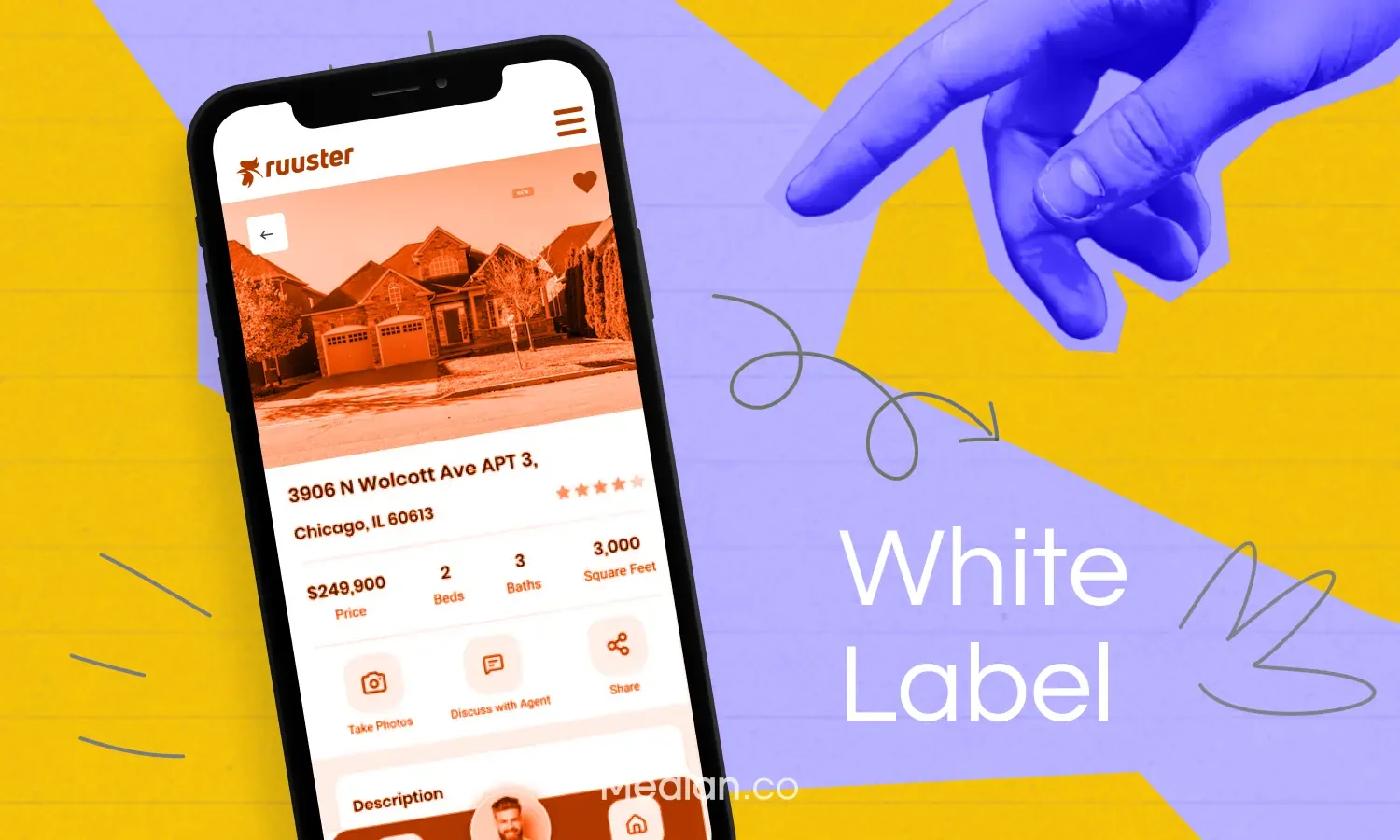
For example, Median.co customer Ruuster (who you’ll learn more about below) is able to develop white label apps from pre-existing websites — which they can then develop into apps, duplicate, rebrand, and provide to a growing list of their customers.
Second, but equally important, since the developers handle the maintenance and updates aspects of the app, this allows enterprises to focus more on their other business needs while simultaneously providing their end users with a high-quality digital experience.
The pros of a white label app
As I’ve already mentioned, a white label app is a quick solution for time-sensitive app development, allowing businesses to deliver high-quality native apps to their clients.
These apps come with many benefits including cost savings, faster deployment, customization and more.
Here are the pros of opting for a white label app:
Competitive cost: With its core functionality already developed, you don't need to worry about building a new app from scratch — making white label apps a budget-friendly option for enterprises looking to develop an app without straining their resources.
Faster deployment: White label apps are faster to deploy — all you need to do is quickly launch your branded app with the pre-built template provided by the app developer.
Customization: Even though the app is pre-built, it is still customizable, allowing enterprises to add their own logos, brand colors, and any other features that ensures brand consistency.
Easy updates and maintenance: A third-party app service will typically handle ongoing updates and any maintenance that needs addressing — ensuring your app is compliant with the app store guidelines in place to protect customer safety and ensure your apps are up-to-date.
Supports scalability and growth: These apps are designed to grow with your business, and easily adjust to your increasing user-base. White labels apps can be a major win for your overall long term business goals if scalability is part of it.
Meets and exceeds business objectives: Since these apps are pre-built, customizable, and taken care of after it's published by the app builders, enterprises can relax and focus on other business goals without worrying about the technical aspects of app development and maintenance.

Get hands-on with Median’s comprehensive documentation, and build your app with ease.

The cons of a white label app
White label apps also come with some limitations — albeit, not many. To full understand their functionality, considering the cons is important.
Here are the cons of using a white label app:
Customization: Customization can also be a drawback. Since white label apps are pre-built, they may have some limitations for business with very specific requirements.
Developer dependency: As a business, you will need to heavily rely on your app development service for ongoing updates, support, and maintenance. Any problems with the app builder can directly impact the app’s overall performance — so choose an app builder that is reliable and responsive (we can think of one — more on this below)
Differentiation: Since the core structure of the app is pre-built and used by multiple enterprises, there is the danger of rolling out apps that ultimately look similar to one another.
Licensing fees: Developing a white label is cheaper, however, these apps come with ongoing licensing or subscription fees that can add up over time to your overall budget.
White label app in action: Ruuster’s white label app for real estate agents
The pros and cons above are useful in theory, but the clearest way to understand whether white label is the right approach for your use case is to see it applied to a real business problem.
Ruuster is a good example because their challenge isn't just building one app, it's building hundreds of them.
Ruuster is a branded mobile app platform which specializes in designing apps for real estate companies. They offer a customized branded native app tailored to every brokerage’s local markets. By ‘customized,’ we mean logos, brand colors, features, splash screens and more.
With Ruuster, real estate agents can engage with their clients directly within their own apps, enhancing user retention and satisfaction — all possible with the help of Median.co.
Ruuster is a prime example of how successful and scalable a white label approach can be. Median took all the heavy lifting for Ruuster when it came to app development — we took care of the technical aspects while keeping Ruuster’s core business functionality on top of the list.
Read more on Ruuster’s successful white label app approach here.
Discover how Median empowers companies to speed mobile app development, engage users, and reduce expenses.
What to evaluate when choosing a white label app platform
Not all white label app platforms are built to the same standard, and at enterprise level the differences matter more than they do for a simple consumer app.
A few things worth evaluating before you commit:
Native functionality depth
A white label app that can only deliver a branded webview with no native features will struggle in the app stores and in the hands of users who expect push notifications, biometric login, and offline behavior.
Look for a platform with a real native plugin library, not a roadmap of features that might ship later.
App store approval track record
White label builds fail review for the same reasons custom builds do, limited functionality, missing privacy policy declarations, incorrect payment flows.
Ask vendors specifically about their approval rate and how they handle rejections. Median.co's 100% approval rate across thousands of apps is a meaningful signal. A vague answer isn't.
MDM and enterprise security support
If your white label app is going to enterprise customers or being deployed internally across a managed device fleet, the platform needs to support MDM compatibility out of the box.
That means managed app configuration, Intune and Jamf compatibility, jailbreak detection, and data loss prevention controls. These are requirements that surface in procurement, not features you can add after the fact.
Median's Enterprise Security plugin was built specifically for this.
It covers screenshot and screen recording blocking, network security policy enforcement to prevent unencrypted requests on both iOS and Android, clipboard access restrictions, and app switcher masking to prevent sensitive content from appearing in recent app previews.
Combined with the Jailbreak/ Root Detection plugin, it gives enterprise customers a validated security configuration that passes IT review and meets compliance requirements across HIPAA, GDPR, PCI DSS, and SOC 2.
Customization depth vs. template rigidity
Some white label platforms give you color and logo swaps and call it customization.
Others let you configure navigation, feature sets, authentication flows, and native plugin combinations per client.
For companies like Ruuster that manage hundreds of customer-branded app experiences, the difference between surface-level and structural customization is significant.
Ongoing maintenance and platform update handling
Both iOS and Android ship software updates that can break MDM configurations, privacy manifest requirements, and SDK integrations.
Ask how the vendor handles those updates and whether that maintenance is included or billed separately.
Why enterprises build white label apps with Median.co
Median.co is a web to app builder that converts any existing website into a fully functioning native iOS and Android app. Its plugin library covers the native functionality enterprise apps actually need.
For white label apps specifically, Median handles the technical layer, native builds, app store submissions, plugin configuration, and MDM compatibility, so your team can focus on the product and customer experience sitting on top of it.
Ruuster runs a branded app platform serving hundreds of real estate brokerages on Median. Whole Foods Market runs an internal workforce app for 91,000 employees on Median. Both are built on the same platform, configured differently for entirely different use cases.
For enterprise teams with security and procurement requirements, Median's enterprise plugin suite covers mobile device management (MDM) and mobile application management (MAM), jailbreak and root detection, biometric authentication, clipboard blocking, screen capture prevention, and HTTPS-only network enforcement.
Book a call with our team to talk through what your white label build requires and what the path to launch looks like.
Launch a full-feature native app without native development!

Frequently asked questions about white label mobile app development
Can I have a multi-tenanted app and then white label it for select clients?
White label apps offer an elevated experience for your high value customers. A multi-tenanted app can be converted into a white label app — you can selectively offer a white label solution to specific customers who might see value in having their brands represented in the app stores.
How to choose a white label app developer?
Median.co is an app developer that is experienced in creating white label apps. Generally, when thinking about a white label app developer — look for a developer that is easy to work with, super-responsive, and understand your business goals. Do not be afraid to ask questions and lay out the foundation of what you need in the beginning. This is where Median.co’s team of experts come in: they are quick to respond to any questions you have about white label apps and can help you build one in a matter of weeks.
How much does it cost to white label an app?
On average, with traditional app development either outsourced or internally, the cost of building a white label app can range from $10,000 to $30,000 for a single platform – Android or iOS. However, it can cost upwards of $70,000 for a multi-platform compatible app with intricate features. With solutions like Median.co, however, businesses now have the ability to realize both iOS and Android-friendly white label apps for a significant fraction of the cost of traditional app development — but with more support, service, access to premium plugins, and the ability to scale your apps and thus scale your revenue.
Will the app stores approve my white label app?
For white label apps to be approved by Apple App Store and Google Play Store, customization is important. Both Google and Apple want every app in their ecosystem to be unique and to add value to their respective audiences — so customize your app for a better chance of success, meaning, customize your app’s brand (icons, screenshots, color, logos, etc) and publish under a different account, Google Play Console account, or Apple Developer account.
If this sounds too complicated, Median.co can assist in creating and publishing your white label app to the app stores, easing the burden of the technical aspects involved in the process. Let Median.co do the heavy lifting for you.
Can a deep linking validator test Universal Links and App Links for white label apps?
Yes. Tools like Median's Deep Linking Validator can help verify that Universal Links on iOS and App Links on Android are configured correctly across white label apps. This includes validating your AASA (apple-app-site-association) file, assetlinks.json file, associated domains, app link settings, and deep link routing behavior. For organizations managing multiple branded apps, a deeplink tester can quickly identify configuration issues that may prevent links from opening the correct app or in-app content. By testing Universal Links, App Links, AASA files, and assetlinks.json configurations before deployment, teams can ensure a more reliable deep linking experience across all app instances.
*DISCLAIMER: This content is provided solely for informational purposes. It is not exhaustive and may not be relevant for your requirements. While we have obtained and compiled this information from sources we believe to be reliable, we cannot and do not guarantee its accuracy. This content is not to be considered professional advice and does not form a professional relationship of any kind between you and GoNative.io LLC or its affiliates. Median.co is the industry-leading end-to-end solution for developing, publishing, and maintaining native mobile apps for iOS and Android powered by web content. When considering any technology vendor we recommend that you conduct detailed research and "read the fine print" before using their services.*