Whole Foods rolled out an app to 91,000 employees without a single mobile developer on staff. A five-person hospitality startup shipped to both app stores in two weeks. What they have in common is building on what they already had instead of starting over. Median helps retail and small business teams of all sizes do the same thing, converting their existing websites into fully functional iOS and Android apps, complete with native features such as push notifications, loyalty, and app store publishing.
Most retail businesses that look into mobile app development for retail get one of two quotes: a number that's higher than they expected or a scope that's broader than what they actually need.
Then they either overbuild, overspend, and run out of budget before launch, or they talk themselves out of it entirely and keep running on a mobile website that's doing half the job.
The businesses profiled in this blog post didn't do either of those things.
WTSO.com recovered a stalled native build, converted their existing site, and shipped with full compliance logic intact. All of them built on infrastructure they already had.converted their existing site, and shipped with full compliance logic intact.
All of them built on the infrastructure they already had.
That's what this guide is about: what a retail mobile app should actually do, what it realistically costs, and how to get fully functional iOS and Android apps without starting over.
Instant Preview
Enter any URL to build your app
What your retail mobile app should do
A retail app and a mobile website are doing different jobs. Your website is there for anyone who finds you, but your app is for the customers who already chose you. The whole point is to make it easier for them to keep choosing you.
This distinction matters because it shapes every web-to-app feature decision. The things that make a mobile website useful (e.g., discoverability, browsing, first-time checkout, etc.) are table stakes for an app, but not what justifies building one.
What justifies mobile app development for retail is the set of behaviors a browser can't support as well.
Since 2014, over 1.7 million apps have been built on the Median.co platform. The six features below are the ones that separate a retail app worth building from one that collects dust:
Shopping and checkout – Your mobile app should feel like your existing e-commerce experience, but optimized for how people actually shop on their phones. This includes a product catalog, search functionality, wishlist feature, and smooth checkout with Apple Pay and Google Pay.
Push notifications – No, not random "we have a sale!" alerts that get apps uninstalled fast. Targeted, personalized ones. Think: "Items you viewed are now 20% off." That degree of personalization the difference between a notification users delete and one they act on. We cover more on push notification strategy in this article: Why your mobile app needs push notification user segmentation by featured contributor Sasha Langholz of OneSignal.
Loyalty – Most retail apps that stick long-term have a loyalty program at the center of them. It gives customers a reason to open your app even when they're not shopping. The mechanics aren't that complicated (e.g., points per dollar, visible balance, redemption at checkout, etc.), but what makes or breaks it is whether your rewards are actually worth something. Tiers that are unreachable and points that expire before anyone uses them tend to do more damage than having no program at all.
Click-and-collect – If you have physical locations, this feature is particularly helpful. A customer orders in the app and picks up in store, which sounds simple enough, but what it actually does is bring people through the door on a schedule you can anticipate. That foot traffic is where upsells can happen; where a customer who came in for one thing leaves with three. It also cuts shipping costs on small orders that probably didn’t make sense to fulfil by mail anyway.
Order history and reorders – For anything a customer buys more than once, whether that's a skincare product, a bag of coffee, a supplement, or a pet food brand, having their last order a single tap away removes the friction from a decision they've already made. Your app just needs to get out of the way and let them get it quickly.
Exclusive access – Early access to sales, limited drops, and members-only products solve a problem that's harder to solve on a website: giving your best customers something they can't get by just Googling you. When your app is the only place to catch a drop before it sells out, or to see a sale 24 hours early, you give someone a reason to keep it on their phone. That's the whole game.
Mobile apps for specific retail contexts
The business case for a mobile app looks different depending on what kind of retailer you are.
Grocery store delivery app
Simply put, the value is in repeat purchase behavior and click-and-collect. Once customers set up their usual order in an app, the friction to reorder is almost zero. Additionally, push notifications for restocked items or weekly specials get opened because they're timely and specific, not generic.
Fashion and apparel shopping app
Loyalty tiers and early access to drops give your best customers a reason to stay inside your ecosystem rather than buying through a marketplace. As an added bonus, size-specific restock notifications are the kind of push that doesn't feel like marketing.
E-commerce app
The WTSO.com situation is common in e-commerce: an existing web platform with solid compliance logic, inventory, and checkout that needs a native mobile experience without a full rebuild. Median's approach means your existing rules carry over. You're not rebuilding the product, you're simply extending it. (There are many other e-commerce mobile apps featured in our examples library to use as inspiration.)
Employee apps in retail
Whole Foods isn't unique here. Retail businesses with large floor workforces often have a communication and scheduling gap between what's possible on the web and what employees actually use day-to-day.
An employee engagement app that handles shift scheduling, push announcements, and access to company communications works better than a mobile-optimized website when employees aren't at a desk.
How to build a retail mobile app without starting from scratch
Many retail teams don't have a mobile engineering team sitting around waiting for a project. They have a website that works, customers who are already on their phones, and no appetite for rebuilding something from scratch that's already doing its job on the web. Sound familiar?
The alternative is converting your existing web product into a mobile app, which is what Median does.
Web-to-app converter: The case for one codebase
If you've been quoted separately for iOS and Android development, you've seen how quickly that math doubles. Maybe it goes without saying, but two separate codebases means two separate build timelines, two sets of engineers, and two ongoing maintenance streams. (For retail apps, where loyalty logic, product catalogs, and push notification behavior need to be consistent across both platforms, any maintenance drift creates problems that compound over time.)
Median builds on a single web foundation that deploys to iOS and Android simultaneously. When you update your web product, both apps reflect it on the same day. There's no separate Android release cycle, no platform-specific bug queue, no version drift. The same update, both stores, same day.
How Median can help
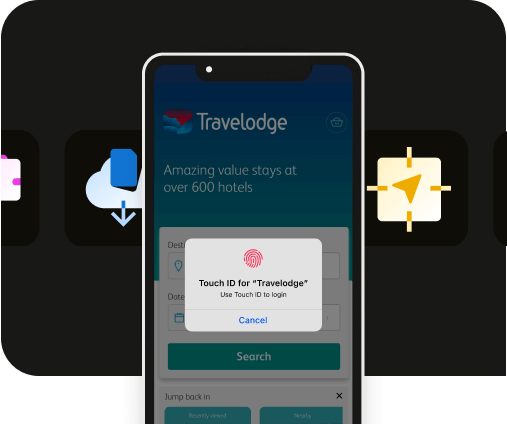
Median wraps your current website or web app in a native shell and adds the native capabilities that a web browser can't deliver, such as the retention driving features we highlighted above, and other capabilities such as biometrics and offline access.
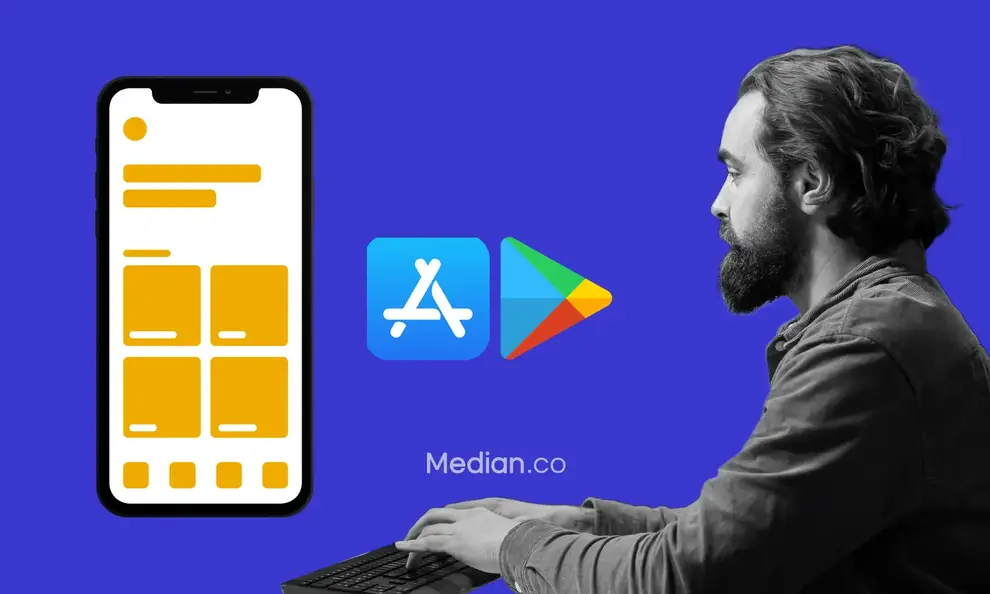
But don't worry, the web-to-app approach isn't a shortcut. Median-built apps go through the same App Store and Google Play review process as any native build, and self-serve apps boast a 98% approval rate for self-serve apps. The approval rate is 100% for apps that use Median’s app publishing service.
And if you decide down the road that you need a fully native build, nothing about starting with Median locks you out of that. Your web infrastructure, your product logic, and your customer data all carry forward.
Long-running e-commerce retailer Wines ‘Til Sold Out, had the opposite experience first. WTSO.com hired a developer for a native build, the project stalled, and they were left with the same problem and a smaller budget. They came to Median, rebuilt on their existing site, and shipped to both app stores quickly with Cordial push notifications and the state-by-state compliance logic their site already handled.
What it costs to build a retail mobile app
The honest answer is that it depends on whether you're building from scratch or converting what you already have, and those two paths have very different cost profiles.
If you're building a custom app from the ground up with product catalog, loyalty program, push notifications, and checkout, you're looking at somewhere between $20,000 and $90,000, depending on scope. Add click-and-collect, advanced loyalty tiers, or personalized push logic, and you're likely toward the higher end.
If you go the in-house route, Median's own cost guide puts the total between $40,000 and $300,000 once you factor in developer salaries (iOS developers average $134,000 annually in the US), HR costs, hardware, software, and the 500 to 2,500 hours of internal time it takes to actually ship. Outsourcing to a third-party agency brings that down to $20,000 to $150,000, but you're still carrying the project management overhead and the risk of a team that doesn't follow through.
If you're converting an existing website or web app using Median, the range shifts significantly.
Self-serve plans start at $179/year. For teams that need dedicated support, app store publishing, and ongoing updates, Median's Business and Enterprise tiers cover the full lifecycle without requiring a mobile engineering hire.
The ongoing maintenance cost is where the math gets most interesting. Two separate iOS and Android codebases means two sets of fixes every time either platform ships a major update. A single web-based foundation means one fix, applied once. Over a three-year horizon, that difference compounds faster than you might expect when you’re signing the initial contract.
Why choose Median for retail mobile app development
Median has been building web-to-native mobile apps since 2014, with over 1.7 million apps built across industries including retail, ecommerce, grocery, and hospitality.
Where other options fall short, lightweight wrappers constrain what you can do, no-code builders often require rebuilding your product from scratch, and enterprise platforms slow you down, Median builds on what you already have. Your existing web infrastructure becomes the foundation for a fully functional iOS and Android app, with native capabilities layered on top.
Whole Foods got a mobile app for 91,000 employees without hiring a single iOS or Android developer. WTSO.com recovered a stalled native build and shipped to both stores quickly. Schedulefly went from web-only to both app stores in two weeks, without pulling its five-person team off product work.
If you're a retail team with an existing website or web product and you want a mobile app that works on both platforms, Median is the path that doesn't require starting over.
If you have a retail app project your team wants to build, talk to sales and we'll help you figure out the fastest path to both stores.
More questions about mobile app development for retail
Can I turn my Shopify store into a mobile app?
Yes. Median integrates with Shopify via the Storefront API, which means your existing product catalog, inventory, checkout, and order management stay exactly where they are. The app pulls from your Shopify backend and adds the native layer on top.
Can I turn my existing website into a retail mobile app without rebuilding it?
Yes, and for most retail teams this is the faster and cheaper path. Median wraps your existing website or web app in a native shell and layers on the native capabilities a browser can't deliver, (e.g., push notifications, biometrics, offline access, etc.) without touching your underlying product logic, inventory system, or checkout flow. Whole Foods did it on a Vue.js application with 91,000 users. WTSO.com did it after a native build stalled and left them with nothing to show. If your website works, that's your foundation.
What's the cheapest way to build a retail mobile app?
It depends on what you're starting with. If you're building from scratch, a scoped MVP from a small studio typically starts around $15,000 to $20,000, and anything significantly below that is usually a template build or offshore work could carry more risk. If you already have a working website, converting it through Median's platform starts at $179/year for self-serve, with full service options covering app store publishing and ongoing updates.
Will a web-to-app converter get approved on the app store?
Yes. Median's self-serve apps have a 98% app store approval rate, and apps that go through Median's publishing service have a 100% approval rate. Apple and Google review what your app does and how it behaves, not what framework it's built on. Median-built apps go through the same review process as any native build.
How long does it take to build a retail mobile app?
With Median, can teams converting an existing website can be live in both app stores within two weeks. Schedulefly, a hospitality scheduling platform serving 225,000 users, shipped in exactly that timeframe. Building a custom app from scratch takes longer, typically 10 to 14 weeks for a scoped MVP and 14 to 20 weeks for a fuller build with click-and-collect, loyalty tiers, and personalized push. The timeline difference comes down to whether you're building on what you already have or starting over.
Can I add push notifications to my existing retail website?
Not through the browser alone, at least not with the reliability and reach that a native app delivers. Web push notifications exist but have significant limitations. For example, they don't work on iOS Safari for most users, opt-in rates are lower, and they can't target based on in-app behavior the way a native push system can. Median adds OneSignal-powered push notifications as a native layer on top of your existing web product, which means you get the targeting and delivery reliability of a native app without rebuilding your site.
Want to learn more about our plugins?
Launch a full-feature native app without native development!
*DISCLAIMER: This content is provided solely for informational purposes. It is not exhaustive and may not be relevant for your requirements. While we have obtained and compiled this information from sources we believe to be reliable, we cannot and do not guarantee its accuracy. This content is not to be considered professional advice and does not form a professional relationship of any kind between you and GoNative.io LLC or its affiliates. Median.co is the industry-leading end-to-end solution for developing, publishing, and maintaining native mobile apps for iOS and Android powered by web content. When considering any technology vendor we recommend that you conduct detailed research and "read the fine print" before using their services.*